Evaluating Motion and Registration in Adaptive Radiotherapy
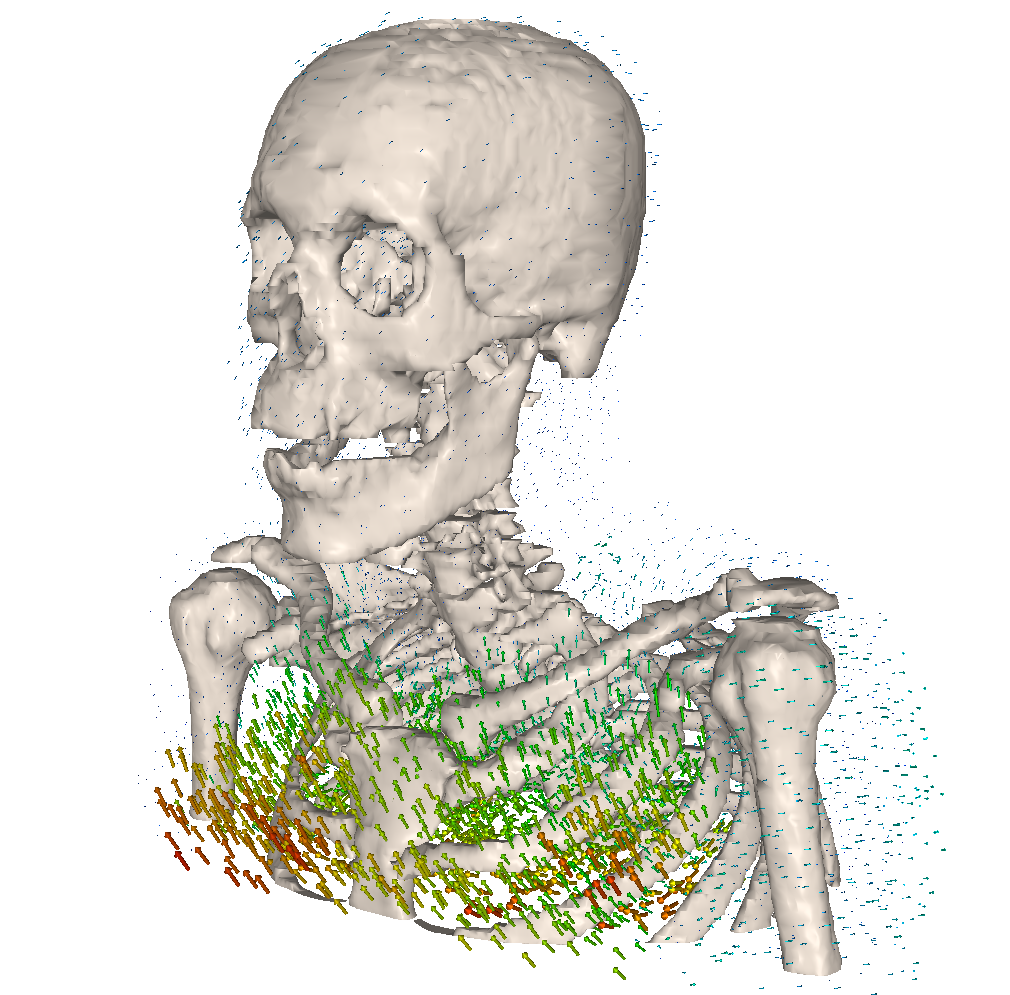
Modern radiotherapy relies on highly precise imaging, yet breathing motion and multimodal uncertainty for example between CT & MRI scans, limit reliable dose delivery and treatment monitoring. Using adaptive lung radiotherapy as a motivating example, we explore how representation learning and principled evaluation metrics can strengthen how motion and registration methods are assessed in medical imaging.
Radiotherapy systems can deliver radiation with millimeter accuracy. However, in the thorax, breathing causes tumors and surrounding organs to move in complex, patient-specific ways. For centrally located lung tumors near major vessels, this motion directly affects treatment safety.
These challenges reflect a broader imaging problem: we routinely perform deformable registration, aligning medical images through voxel based deformations, but rarely know the true correspondence between them. This raises a key question:
How can we evaluate motion and registration algorithms when no ground truth exists?
Dose Accumulation and ADC Correlations:
Adaptive radiotherapy combines multiple modalities. CT provides electron density for dose calculation, MRI improves soft-tissue visualization, and diffusion-weighted MRI yields quantitative biomarkers such as the apparent diffusion coefficient (ADC). ADC is a measure of water diffusion in tissue, which can indicate tumor cellularity and therefor the treatment response.
Using longitudinal CT and MRI data, we analyzed whether spatial ADC changes correlate with accumulated radiation dose. Precise dose accumulation required deformable CT to CT registration, which performed reasonably well, though small spatial differences led to dose deviations of up to 4 Gy in tumor regions.
MRI to CT registration was more challenging but needed to study whether radiation dose correlates with spatial ADC changes.
This multimodal registration problem involves different imaging physics, contrasts, distortions, and anatomical changes over time. Despite careful preprocessing, local mismatches of several millimeters remained and propagated into correlation studies.
When investigating the relationship between ADC and accumulated dose, we found that the dose itself had only a minor impact. Instead, most of the variability in ADC was explained by anatomical and temporal factors. However, these results were significantly affected by uncertainties in the registration of the dose distribution and the ADC maps.
This difficulty in aligning images motivates the use of advanced representations and metrics, which we discuss next.
Beyond Intensity: Learned Representations and Metrics:
Traditional registration struggles in low-contrast or multimodal regions. MedDIFT uses multi-scale voxel descriptors from a pretrained diffusion model to capture geometric and semantic structure, achieving competitive correspondence accuracy while operating without any task-specific training.
Evaluating anatomical fidelity also requires better metrics. Fréchet Radiomic Distance (FRD) uses standardized, interpretable features to assess generative models and image correspondence, capturing structural consistency and correlating with radiologist-perceived quality.
A robust evaluation of a medical image registration combines anatomical consistency, distribution-based similarity, and task-specific validation such as biomarker stability. Integrating learned representations and domain-aware metrics not only enables reproducible and meaningful assessment of motion and registration but also provides a foundation for developing future registration methods that are more accurate and clinically reliable.
Publications
MedDIFT: Multi-Scale Diffusion-Based Correspondence in 3D Medical Imaging
Zhang X, Reithmeir A, Kögl F, Braren R, Schnabel J, Lang D - arXiv - 2025
Fréchet Radiomic Distance (FRD): A Versatile Metric for Comparing Medical Imaging Datasets
Konz N, Osuala R, Verma P, Chen Y, Gu H, Dong H, Chen Y, Marshall A, Garrucho L, Kushibar K, Lang D, Kim G, Grimm L, Lewin J, Duncan J, Schnabel J, Diaz O, Lekadir K, Mazurowski M - arXiv - 2024