LUCYD
Keywords: Deconvolution, Image restoration, Deblurring, Image enhancement
The process of acquiring microscopic images in life sciences often results in image degradation and corruption, characterised by the presence of noise and blur, which poses significant challenges in accurately analysing and interpreting the obtained data. We propse LUCYD, a novel method for the restoration of volumetric microscopy images that combines the Richardson-Lucy deconvolution formula and the fusion of deep features obtained by a fully convolutional network. By integrating the image formation process into a feature-driven restoration model, the proposed approach aims to enhance the quality of the restored images whilst reducing computational costs and maintaining a high degree of interpretability.
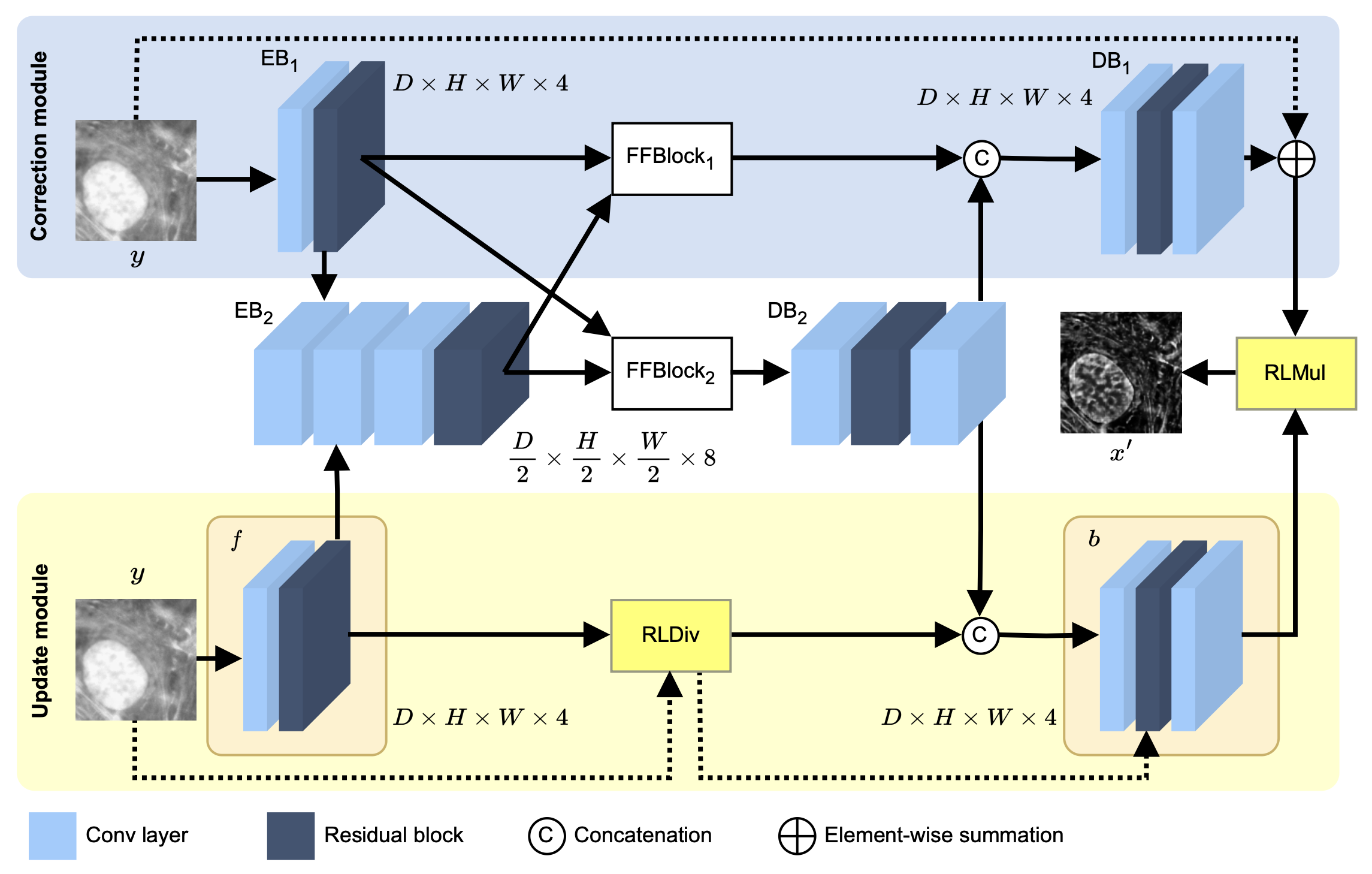
Architecture of the LUCYD network © Tomáš Chobola
Find LUCYD on Helmholtz Imaging Connect
Authors: Tomáš Chobola, Gesine Müller, Veit Dausmann, Anton Theileis, Jan Taucher, Jan Huisken, Tingying Peng
Publications
LUCYD: A Feature-Driven Richardson-Lucy Deconvolution Network
Chobola T, Müller G, Dausmann V, Theileis A, Taucher J, Huisken J, Peng T - Lecture Notes in Computer Science - 2023