FastSurfer
Keywords: Image processing, Data analysis, Mri, Open source, Neuroimaging, Deep learning
Quick Tutorial:  Full Tutorial: Full Documentation:

FastSurfer is a fast and accurate deep-learning based neuroimaging pipeline for the automated processing of structural human brain MRIs. Based on a T1-weighted MRI you get everything you need for quick structure localization (whole brain segmentation in under 1 minute), extraction of quantitative measures, group analysis of your cohort, or structural pre-processing for fMRI/diffusion analysis:
- Deep-learning based whole brain segmentation into 95 classes in under 1 minute on the GPU, and 20 min on the CPU
- Desikian-Killiany-Tourville atlas segmentation (=33 subcortical structures and 31 cortical structures / hemisphere)
- Cerebellar lobe segmentation into 27 structures
- ROI-wise volume statistics
- Supports native high-resolution segmentation (< 1.0mm^3, no resampling)
- Full FreeSurfer-conform outputs in approximately 45 min (+ 30 min for spherical registration)
- Cortical surfaces (white, pial)
- Surface measures (thickness, curvature and more)
- Surface labels and annotations (aparc.annot, cortex.label, ...)
- Point-wise surface statistics and ROI-wise volume statistics
- Spherical registration to FSAVERAGE - directly usable for inter-subject registration and alternative atlas registration (e.g. Destrieux, Desikian-Killiany)
- Supports native high-resolution MRIs (< 1.0mm^3, no resampling)
Check-out our Fastsurfer Colab Tutorial for a first taste of FastSurfer and generate your first FastSurfer segmentation in just three clicks!
Beyond the speed-up compared to traditional tools, FastSurfer and its components are highly accurate, reliable and sensitive to group effects. To ensure usefulness, we extensively validated the entire pipeline using a number of publicly available datasets (see Proof of Concept).
Further, running FastSurfer is easy as pie - a single command does all the work for you. The full documentation can be found on our github page.
./run_fastsurfer.sh \
--sd /home/user/my_fastsurfer_analysis \ # output dir (=SUBJECTS_DIR in FreeSurfer)
--sid SUBJECT_ID \   # result folder (auto-generated in output dir)
--t1 /home/user/my_mri_data/T1.nii.gz # Location of your T1-weighted MRI
We also provide Docker and Singularity container with all dependencies installed in it. You only need a valid FreeSurfer license for the surface stream, which is normally called .license or licence.txt and can be found in your FREESURFER_HOME directory or you can download it for free at https://surfer.nmr.mgh.harvard.edu/registration.html.
docker run --gpus all \
           -v /home/user/my_mri_data:/DATA_INPUT_DIRECTORY \
           -v /home/user/my_fastsurfer_analysis:/DATA_OUTPUT_DIRECTORY \
           -v /home/user/my_fs_license_dir:/fs_license \
           --rm --user $(id -u):$(id -g) \
           deepmi/fastsurfer:latest
                     --sd DATA_OUTPUT_DIRECTORY \
                     --sid SUBJECT_ID \
                     --t1 DATA_INPUT_DIRECTORY/T1.nii.gz \
                     --fs_license /fs_license/.license \
Proof of Concept
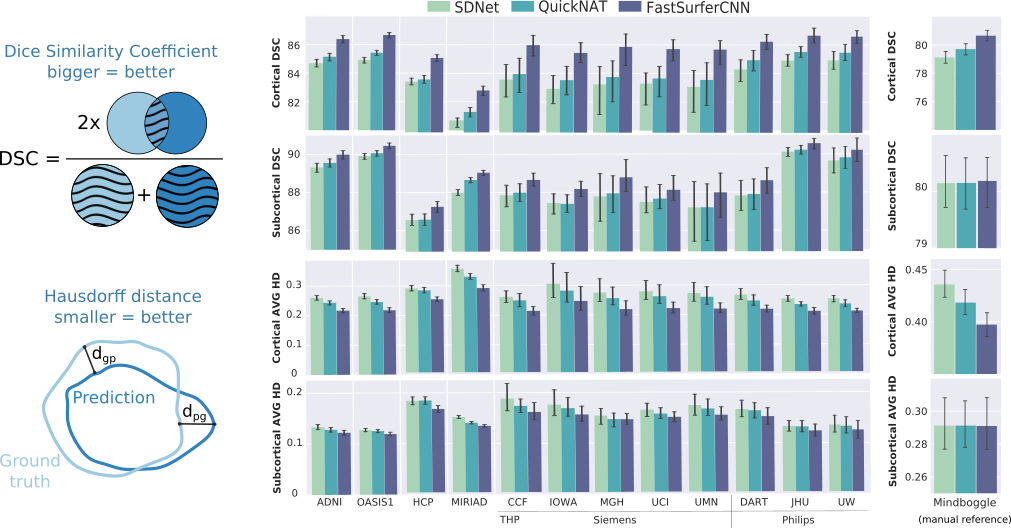
1. Accuracy and Generalizability - How good is the whole brain segmentation generated by FastSurfer?
Answer: Very good! FastSurfer outperforms other deep-learning architectures by a significant margin both with respect to FreeSurfer and a manual standard (Mindboggle). It generalizes well across five different datasets including subjects with different disease states (e.g. cognitive normal, mild cognitive impaired or demented subjects in OASIS, ADNI, MIRIAD), different vendors (e.g. THP), age groups, downsampled and defaced images (e.g. HCP) and alternative T1-imaging protocols (e.g. MIRIAD)
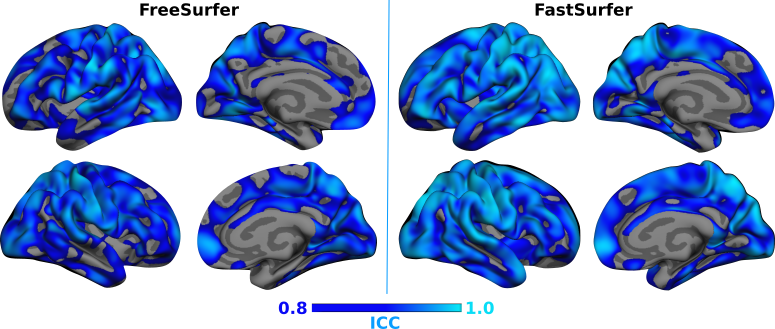
2. Reliability - How well does FastSurfer reproduce results across scans with minimal anatomical variations (Test-Retest)?
Answer: FastSurfer is highly reliable as demonstrated by the close agreement between the thickness and volumetric measurements for 20 Test-Retest subjects from OASIS1. FastSurfer exhibits high test-retest reliability and improves agreement between the cortical thickness measurements compared to FreeSurfer.
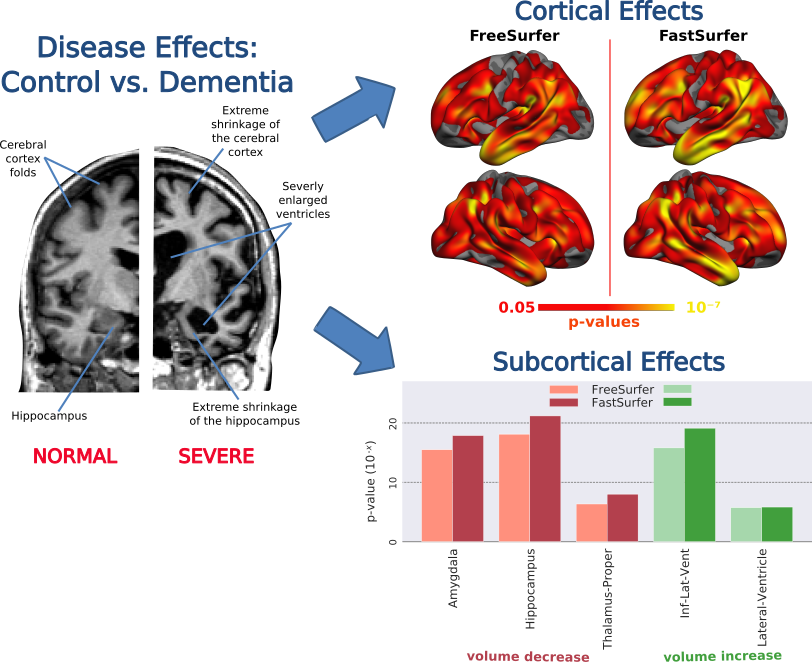
3. Sensitivity - How well does FastSurfer detect significant effects in the data?
Answer: FastSurfer is capable of accurately reproducing known disease effects in a control versus dementia cross-sectional group study. Reduced cortical thickness in regions associated with dementia (e.g. temporal lobes) as well as subcortical volume differences (e.g. enlarged ventricles, shrunken Hippocampus) are robustly detected with increased sensitivity relative to FreeSurfer.
Tool and Paper
FastSurfer is available as open source at github.
An accompanying set of quality control tools can be found at github.
In-depth information about FastSurfer can be found in our papers: FastSurfer, FastSurferVINN, CerebNet.
Or watch our small presentation (10min) on YouTube.
Tutorial
- A set of detailed tutorials for running Fastsurfer can be found within the FastSurfer github repository in the Tutorial Directory
Publications