XRAYPAC
Keywords: Xfel, X-ray, X-ray free-electron laser, Light-matter interaction, Radiation chemistry, Structural imaging
Rapid development of x-ray free-electron laser (XFEL) science has taken place in recent years due to the consecutive launch of large-scale XFEL facilities such as LCLS in the U.S., SACLA in Japan, European XFEL in Germany. Research areas such as ultrafast chemical dynamics, warm dense matter physics or coherent x-ray imaging take advantage of the unprecedentedly high intensities of XFELs, opening up new opportunities to observe, predict, and manipulate matter at the atomic spatial and temporal scales. A single XFEL pulse can induce very complex dynamics within matter initiated by core-hole photoionization and subsequent relaxation processes. Owing to the multifaceted nature of these phenomena, the development and employment of suitable theoretical models becomes imperative in elucidating the complexities.
In our endeavor to achieve this goal, we have successfully engineered a sophisticated software package named XRAYPAC, within the CFEL-DESY Theory Division. XRAYPAC consists of the following computer codes:
- XATOM
- XMOLECULE
- XMDYN
XATOM is an integrated toolkit to describe ab initio electronic structure and dynamics of atoms interacting with x-rays. XMOLECULE is for ab initio molecular electronic structure calculations for modeling ultrafast x-ray experiments. XMDYN is developed for modeling dynamics of matter induced by high-intensity x-rays, which utilizes atomic data calculated using XATOM, and is particularly designed for large polyatomic systems. These codes operate collectively as well as separately based on the nature of the problem and have already demonstrated their potential in many applications targeting the modeling of experiments at XFELs. The toolkit has been instrumental in predicting and facilitating comparisons across a broad spectrum of experiments, ranging from Coulomb explosion to x-ray molecular imaging.
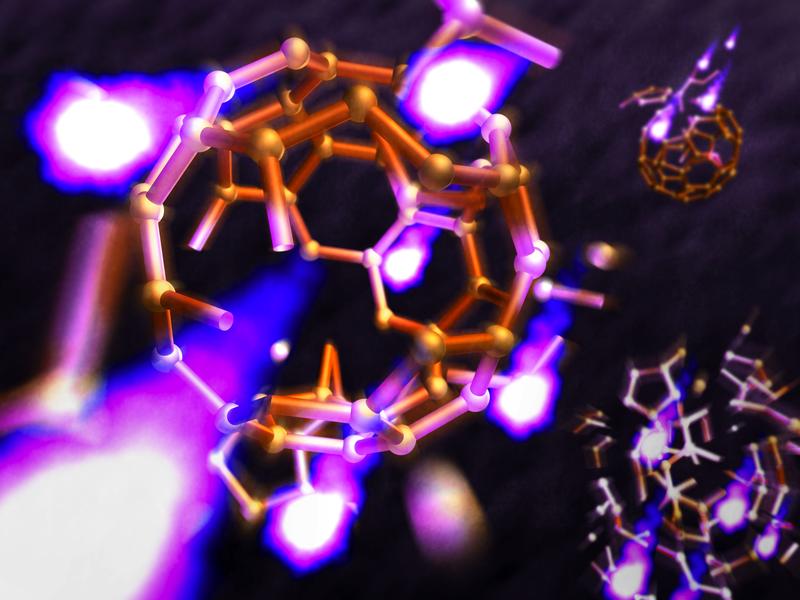
Artist's impression of a buckyball in an X-ray laser flash. Credit: Greg Stewart/SLAC
Publications
XRAYPAC
Inhester L, Jurek Z, Son S, Santra R, Malik Muammad A - Zenodo - 2023
XMDYNandXATOM: versatile simulation tools for quantitative modeling of X-ray free-electron laser induced dynamics of matter
Jurek Z, Son S, Ziaja B, Santra R - Journal of Applied Crystallography - 2016
X-ray multiphoton ionization dynamics of a water molecule irradiated by an x-ray free-electron laser pulse
Inhester L, Hanasaki K, Hao Y, Son S, Santra R - Physical Review A - 2016
Efficient electronic structure calculation for molecular ionization dynamics at high x-ray intensity
Hao Y, Inhester L, Hanasaki K, Son S, Santra R - Structural Dynamics - 2015
Femtosecond X-ray-induced explosion of C60 at extreme intensity
Murphy B, Osipov T, Jurek Z, Fang L, Son S, Mucke M, Eland J, Zhaunerchyk V, Feifel R, Avaldi L, Bolognesi P, Bostedt C, Bozek J, Grilj J, Guehr M, Frasinski L, Glownia J, Ha D, Hoffmann K, Kukk E, McFarland B, Miron C, Sistrunk E, Squibb R, Ueda K, Santra R, Berrah N - Nature Communications - 2014
Impact of hollow-atom formation on coherent x-ray scattering at high intensity
Son S, Young L, Santra R - Physical Review A - 2011