Hype-Spectral: A Top-Performing Solution for Soil Properties Estimation from Satellite Imagery
Accurate estimation of soil properties is of major interest for optimizing agricultural management. While laboratory methods are costly and spatially limited, remote sensing provides a scalable solution by utilizing spectral reflectance data to infer soil characteristics non-invasively. However, the machine learning models developed to decode these complex spectral relationships are often lacking interpretablity. Explainable AI (XAI) methods are therefore critical for improving the trustworthiness of the model predictions.
Hype-Spectral is a solution submitted to the HYPERVIEW2 ESA Φ-Lab Challenge and was awarded with the first place. The challenge focused on estimating soil nutrient parameters, namely Iron, Zinc, Boron, Copper, Sulphur, and Manganese, from multispectral and hyperspectral satellite imagery.
The Challenge
HYPERVIEW2 consisted of two phases:
- Develop a model with the highest prediction performance, and
- Design explainable AI (XAI) methods to assess model robustness and interpretability
The dataset combined Sentinel-2 multispectral imagery and PRISMA hyperspectral imagery with correpsonding ground truth measurements for the six soil properties at the field-level.
The Hype-Spectral Approach
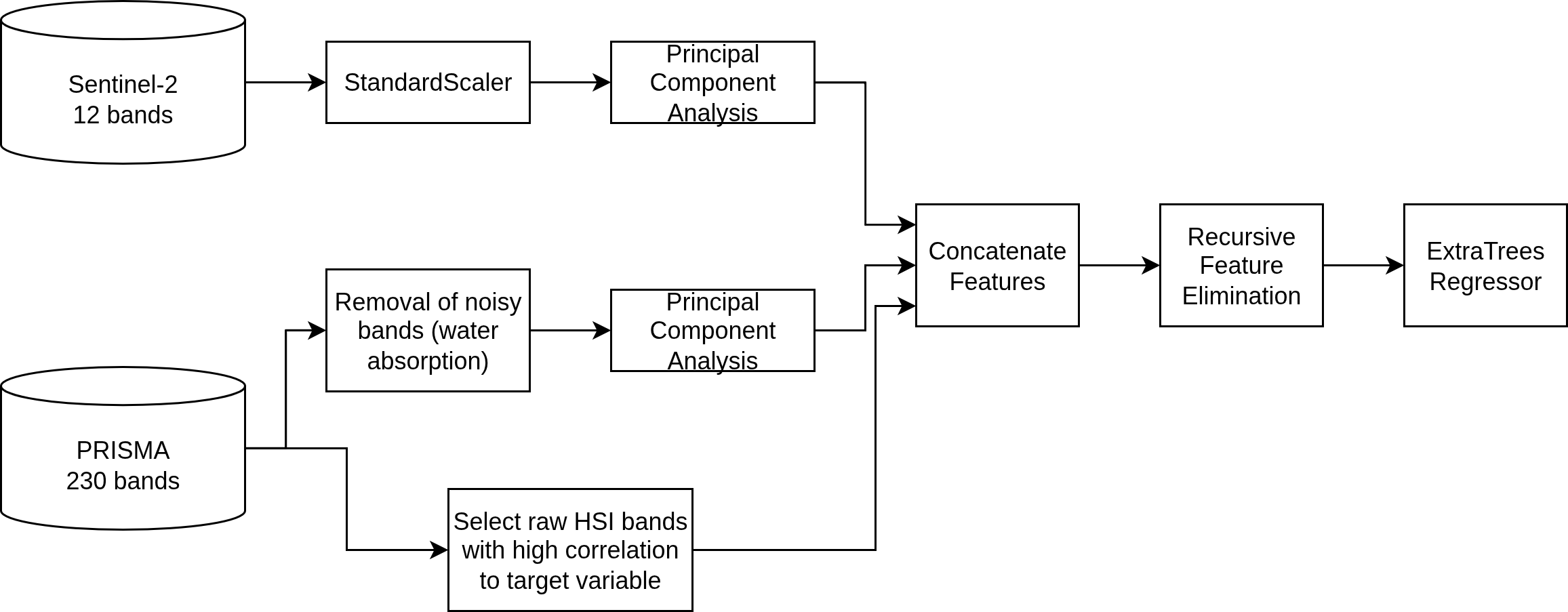
The solution employed an Extremely Randomized Trees ensemble regressor with a carefully designed preprocessing pipeline. The approach computed mean reflectance per field, applied principal component analysis to both modalities, and used recursive feature elimination to identify optimal predictors for each soil property. PRISMA bands affected by atmospheric water absorption were excluded to improve performance.
Explainable AI for Interpretability
For the XAI phase, a model-agnostic framework using SHAP values was developed. The analysis revealed:
- Spectral band importance: Narrow spectral ranges with high importance across soil properties, as well as soil property-specific spectral band importances, were identified
- Modality contributions: PRISMA hyperspectral features contributed more significantly to predictions, highlighting the value of spectral resolution
- Robustness testing: Evaluation of susceptibility to input noise showed varying sensitivity depending on the soil property
This XAI approach provides interpretable insights directly from raw spectral bands, making the model's decision-making process more transparent and trustworthy.
The code is publicly available on GitHub